The
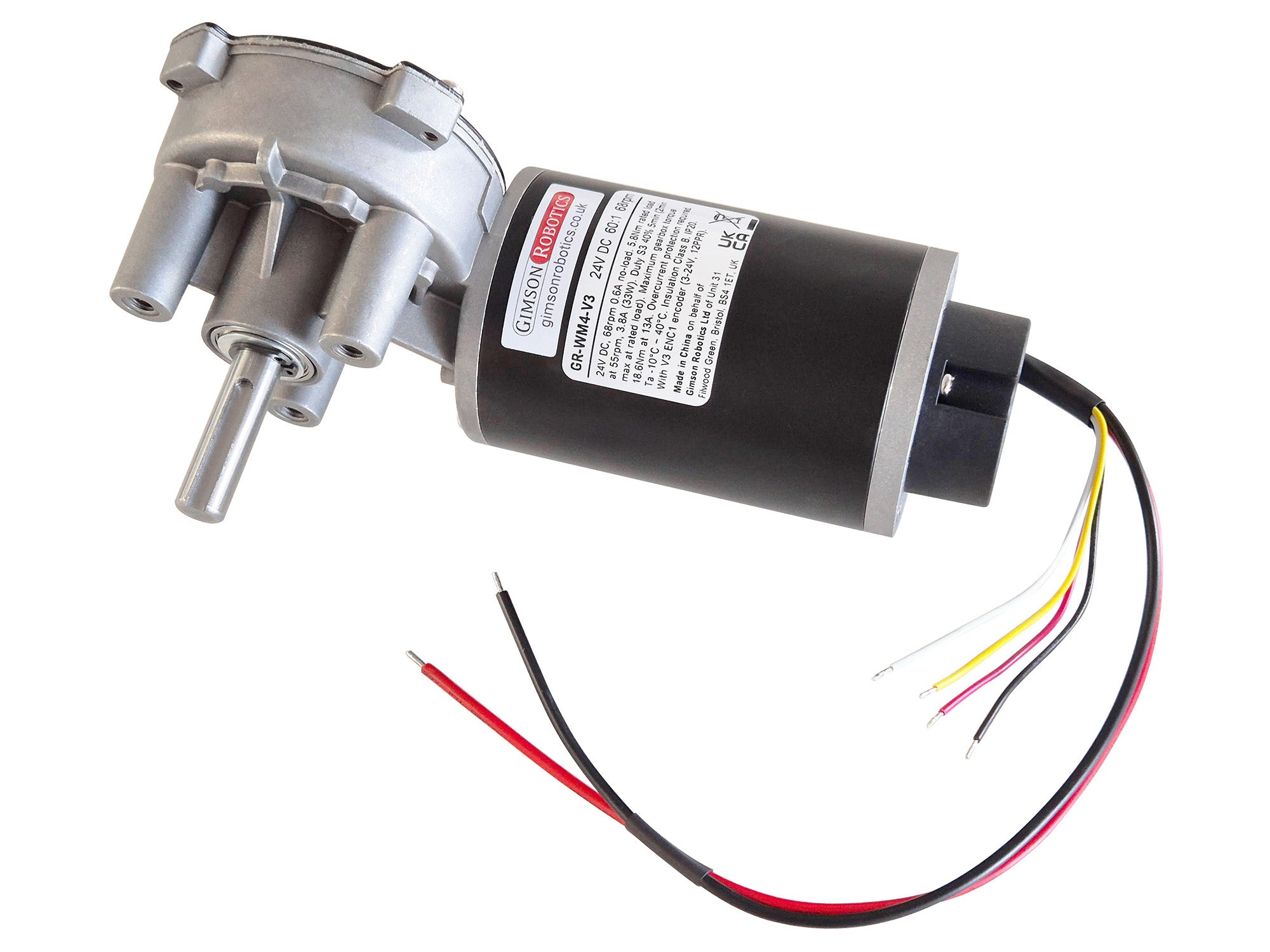
GR-WM4-V3 is a compact high-torque solution for intermittent load applications. Potential applications include electric window or door openers (often used with rack & pinion or belt drives), winches, turntables, special effects (theatre, TV), and home automation. A PDF datasheet for the motor
is available here.
The body houses a steel and bronze single-stage 60:1 gear reduction, within a cast aluminium gearbox. A useful characteristic of this is that in most cases the transmission is self-locking; the effect comes from the geometry of the worm itself: its lead angle is shallow enough that the tangential force a load produces at the gear teeth is overcome by friction at the contact between the worm and the worm wheel, so the load simply cannot push the worm into rotation. Self-locking is not absolute, however. Severe vibration, shock loads, or rapidly reversing (in other words, oscillating) loads can momentarily reduce the effective friction at the tooth contact and allow the gearbox to creep or back-drive. The behaviour should therefore be verified in the end application, against the expected loading, before being relied upon.
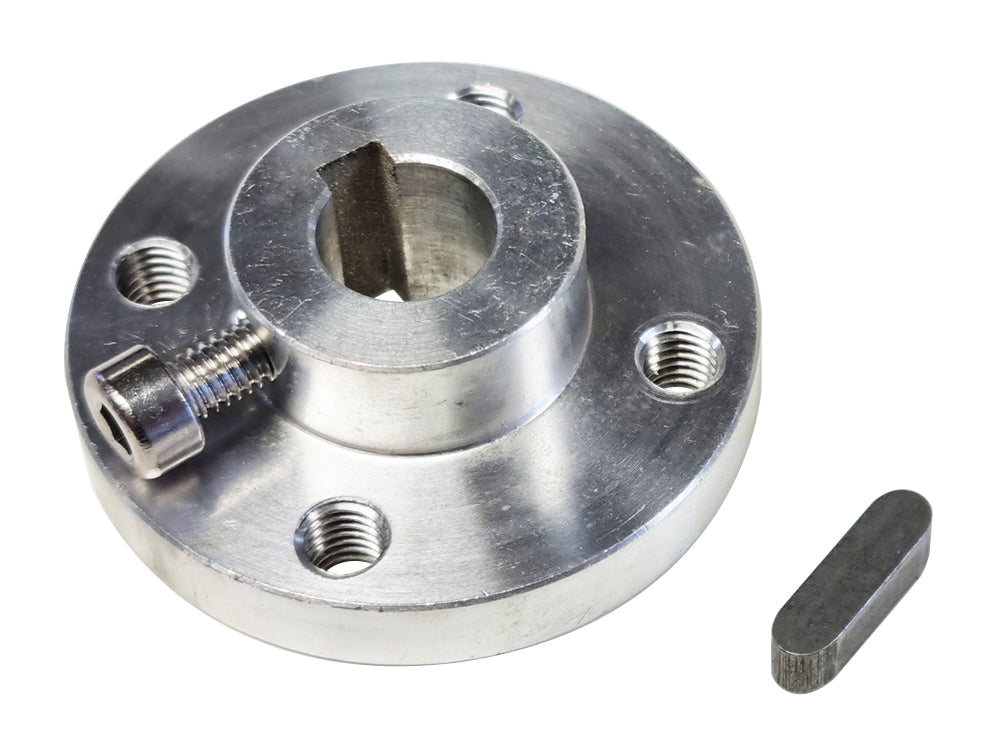
The 10mm diameter 35mm long steel output shaft, with a 4mm groove, provides a convenient mounting profile which is compatible with many readily available couplers and bearings, including our
10mm mounting hubs. The motor is mounted via three M6 tapped holes, on a 50.8mm PCD about the output shaft (see drawing further down this page).
When mounting loads on to the output shaft bear in mind that larger-sized radial loads (those acting perpendicular to the shaft) should be supported by additional bearing/bushings, to avoid putting too much stress on the gearbox and shaft (which is rated up to an 8Nm radial load, equivalent to 228N applied across the end of the 35mm shaft). For example, a wheel generating a load acting at the end of the shaft (35mm out) ought to be supported by a bearing on the opposite side too, if the load on the wheel is expected to be greater than 20kg.
Inside, the motor uses both inductors and capacitors to minimise radiated electrical noise, intended to save future headaches when incorporating the motor into products that need to meet EMC standards.
CAD models are available, please contact us for a copy.
Integrated Encoder
The motor has a hall-sensor based quadrature encoder mounted to its rear, inside the black plastic rear cover. The encoder is not required for operation (and won't affect operation if left disconected), but for many projects it provides very useful feedback of the speed, and relative position, of the motor. It is accessed via the thinner Red, Black, White and Yellow wires. Positive power for the encoder (<10mA) should be provided to the Red lead (+VCC 3.3-24V DC), and Black should be connected to ground/GND.
It has a dual-channel output (Channel A White lead, Channel B Yellow lead), with 6 complete pulses per channel, per rotation of the motor itself (12 PPR across both channels); or 60 x 6 = 360 pulses, per channel, of the output shaft given the 60:1 gearbox ratio. One of the channels is out of phase with the other, as such it is possible to tell both the speed (from pulse frequency) and direction (by reading the pulses of one channel and comparing it to the other) of the motor. The nature of the signals that are generated is illustrated below.
User Advice
This motor operates like any other DC motor and so may be used at voltages other than the nominal 24V with changed operating characteristics (please be aware that the warranty does not cover operation above 24V, which is likely to shorten the lifespan). Reducing the voltage reaching the motor will decrease the output speed and the torque, while increasing the voltage will increase the speed and the torque (torque is directly related to current).
To change the direction of rotation invert the polarity of the DC supply to the two motor wires (invert positive and negative). This is usually done via a control switch or controller, for example our
GR-MOT1 or
GR-SYNC controllers handle polarity inversion themselves.
You must fit circuit protection to protect both the motor and your power source/cabling from damage due to overload. Our GR-MOT1 and GR-SYNC controllers can provide suitable protection, when adjusted appropriately to each application/load.
Make sure to read the performance tables for the motor below (or
on the datasheet), so that you have an understanding of the torque, current and speed that you can expect from it. If you're unsure about selecting the appropriate motor for the task please send application (loading) details
over to us and we'll talk through the options.
Motor Dimensions
Please see drawing below. CAD models are available, please contact us for a copy.

Construction Detail
Mounting
3 x M6 tapped holes, each 16mm deep. PCD 50.8mm (around output shaft).
Overall size
Approximately 184mm long, 101mm tall, 72.2mm deep (excluding output shaft).
Body material
Cast aluminium gearbox housing, steel motor casing.
Gearbox type
Single-stage worm transmission with steel worm and bronze (ZCuSn10P1) worm-wheel.
Maximum gearbox torque
Up-to 190kg-cm (18.6Nm), as limited by the motor shaft bearings. Be aware that at higher voltages the motor itself is easily able to generate greater torque than this (see table below), so ensure that there is overcurrent protection, or a mechanical clutch, in place to prevent it exceeding this mechanical rating, if there is a possibility that your application may go beyond it
Operating temperature
Ambient: -10°C ~ +40°C. The motor is not suitable for unprotected outdoor use. Motor insulation class B (up-to 130°C hot spot temperature).
Shaft type
10mm diameter (h7) by 35mm long. Features a 26mm long, 4mm wide and ~2.2mm deep rectangular keyway.
Shaft support
Dual deep-groove 6900Z (10mm ID) ball bearings
Radial load rating
Up-to 82kg-cm (8Nm). Equivalent to approximately 23kg across the end of the shaft
Weight
1420g, excluding optional lead/connector additions
Motor Performance (at output shaft)
No-load speed
68rpm
34rpm
No-load current
0.5A
0.4A
Continuous rated torque, speed (maximum 40% duty, up-to 2-minutes continuous)
5.8Nm
5.8Nm
Rated load speed
55rpm
21rpm
Rated load current
3.8A
3.8A
Maximum gearbox torque
190kg-cm (18.6Nm)
190kg-cm (18.6Nm)*
Speed at maximum gearbox torque
26rpm
n/a - at Stall
Current for peak gearbox torque
13A
n/a - at Stall
Stall current
22.6A
11.3A
The maximum (short duration) output torque of the gearbox is 190kg-cm. You must avoid shock/impact loads that might exceed this.
The maximum safe current values must not be reached (the values highlighted in Red), or else the motor or gearbox could be permanently damaged.
*The motor stall torque when run at 12V is approximately 15.4Nm, however shock/impact loads must still be avoided to ensure that the gearbox is not overloaded.
Be aware that some of the values above are extrapolated from other measurements and it's normal for there to be some variance from motor to motor; you should allow for a safety factor of at least 10% above/below the given values when designing for your application. Motor performance may vary if driven via PWM, due to interactions with the filtering components inside the motor (this will depend on the supply voltage and PWM frequency and duty). Be sure that any equipment that you use with the motor (power source and controller) is capable of handling the currents that the motor may demand, whilst also being able to limit the current to protect the motor in the event of an overload. Warning: Continuous operation at 3.8A is very likely to lead to overheating, hence the 40% duty cycle limit. As an example, if operating for 60 seconds, the motor should then pause for at least 90 seconds before the next operation.